AI Will Shift the Bottleneck from Production to Judgment
For a long time, making games has been constrained by production.
Ideas were not the scarce part. There have always been more game ideas than teams could build, more worlds than budgets could support, more concepts than pipelines could absorb, and more community requests than live teams could realistically respond to.
The bottleneck was often execution: art capacity, engineering time, content volume, localisation, QA, tooling, marketing assets, community operations, and live-ops bandwidth. Even when the creative direction was clear, the amount of coordination required to move from idea to playable experience was enormous.
AI is starting to change that.
Not overnight. Not cleanly. And not without real concerns around jobs, ownership, quality, trust, and creative integrity. But the direction of travel feels increasingly clear: AI will reduce the cost of producing many things that used to be slow, expensive, or technically inaccessible.
That does not mean production stops mattering.
It means production may no longer be the main constraint.
The new bottleneck will be judgment.
Creation will become more accessible
The most obvious impact of AI in gaming is speed.
Faster prototyping. Faster concepting. Faster code assistance. Faster localisation. Faster asset exploration. Faster campaign iteration. Faster research. Faster internal workflows.
That matters.
But speed is only the surface-level story. The deeper shift is access.
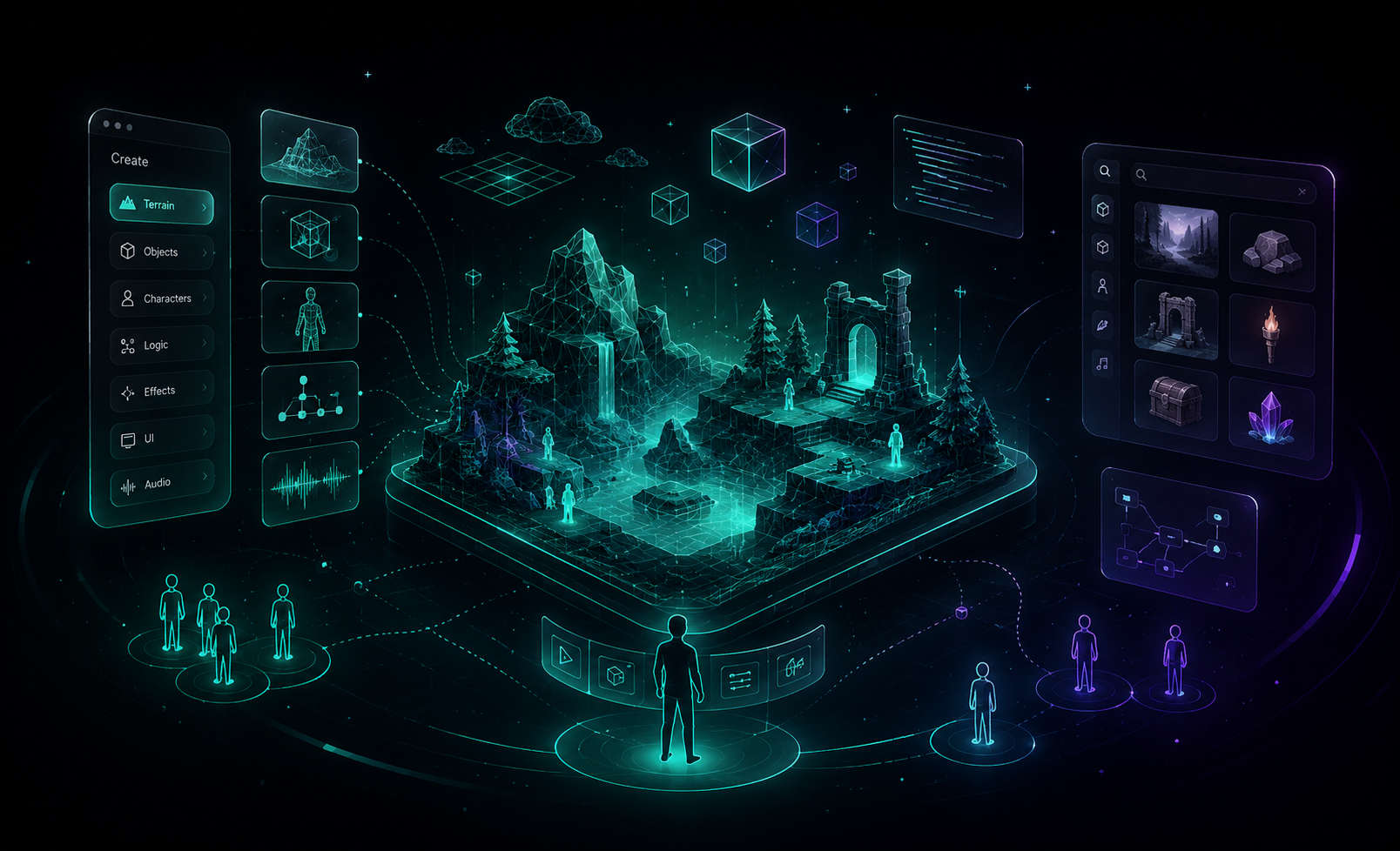
AI will allow more people to participate in game creation. Smaller teams will be able to test bigger ideas. Non-technical creators will be able to express themselves in more playable ways. Communities will have better tools to remix the worlds they love. Live teams may be able to respond faster to player behaviour. Publishers may be able to explore more formats, more markets, and more community-led extensions around their IP.
That is exciting.
I don’t think the best version of this future is “AI makes games instead of people.”
I think the better version is: AI allows more people to make more of the things they already wanted to make.
That distinction matters.
Because games are not just content. Games are systems, emotions, habits, communities, identities, competitions, rituals, and memories. The output is not the experience. The experience is what players feel, understand, repeat, share, and care about.
AI can help produce more material.
It cannot automatically decide what deserves to exist.
Abundance creates a new problem
If AI makes creation easier, the amount of game-related content in the world will increase dramatically.
More prototypes. More trailers. More characters. More skins. More dialogue. More lore. More worlds. More UGC. More marketing. More live content. More community experiments. More games that look polished earlier than they normally would.
Some of that will be brilliant. Some of it will be useful. Some of it will be forgettable. Some of it will be noise.
That is where I think the conversation around AI in gaming needs to mature.
The important question is not only: “What can we now make?”
It is also: “What should we make?”
That is a much harder question.
When production becomes easier, taste becomes more important. Strategy becomes more important. Creative direction becomes more important. Community understanding becomes more important. IP stewardship becomes more important. Trust becomes more important.
The teams that win will not simply be the teams that generate the most output.
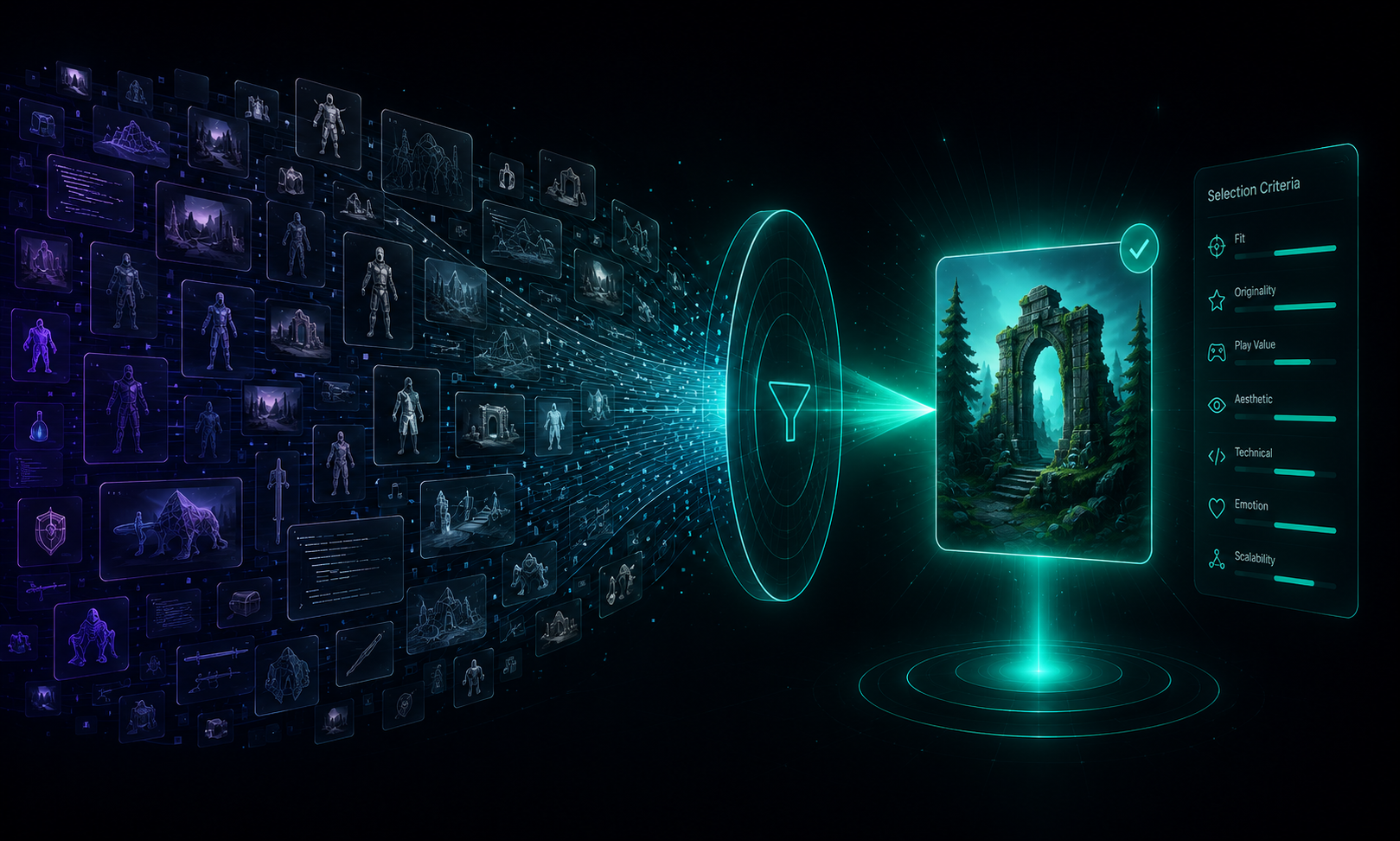
They will be the teams that know what to keep, what to discard, what to polish, what to protect, what to test, what to scale, and what to leave alone.
In that world, judgment becomes the advantage.
The value of IP may increase, not decrease
One assumption I often hear is that if AI makes content easier to create, existing IP becomes less important.
I suspect the opposite may happen.
When the market is flooded with more content, players will look for signals they can trust. Worlds they already care about. Characters with meaning. Communities with history. Competitive scenes with stakes. Creators with credibility. Brands that have earned emotional permission.
That does not mean only established IP will win.
New worlds will absolutely be built. AI may help new creators and smaller teams break through in ways that were previously impossible.
But abundance tends to increase the value of meaning.
A character is not valuable because it can be rendered. A world is not valuable because it has lore. A tournament is not valuable because it has a bracket. A game is not valuable because it has assets.
Value comes from the relationship players build with it over time.
That is why I think publishers, platforms, and IP owners still have a major role to play in the AI era. But the role may evolve.
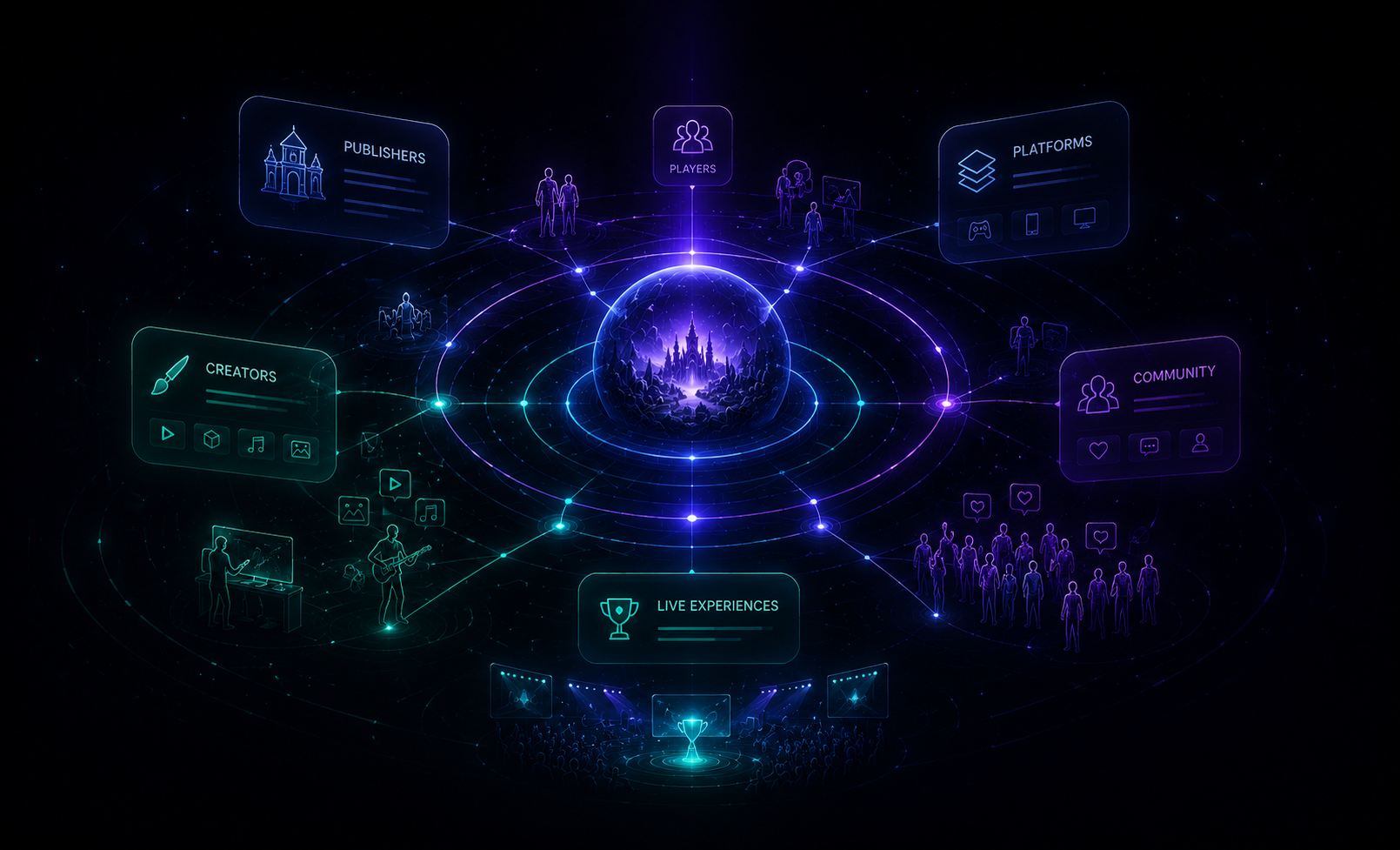
It will be less about controlling every piece of production and more about orchestrating ecosystems where creation, community, rights, trust, and distribution work together.
The best partnerships in gaming may become more creative, more technical, and more community-led.
Not just: “Can we license this asset?”
But: “How do we let people participate in this world without damaging what makes it valuable?”
The first useful AI may be invisible
A lot of the public conversation around AI in gaming focuses on player-facing experiences: AI NPCs, generated quests, infinite worlds, personalised stories, real-time content creation.
Those are interesting. Some will matter a lot.
But I think many of the most useful early applications of AI in gaming may be almost invisible to players.
Better internal research. Faster synthesis of community feedback. Smarter QA workflows. Localisation support. Creator discovery. Partner planning. Competitive insights. Moderation tools. Player support. Live-ops analysis. Marketing iteration. Broadcast clipping. Automated documentation. Faster prototyping of pitch concepts before expensive production begins.
This is less glamorous than a fully AI-generated world, but it may be more immediately valuable.
Gaming companies are complex operating systems. There are creative teams, product teams, commercial teams, publishing teams, community teams, esports teams, regional teams, platform teams, and external partners all trying to move in sync.
AI can create leverage inside that system.
Used well, it can reduce busywork and increase the amount of time people spend on judgment, creativity, and player understanding.
Used badly, it can create more noise, more generic output, and more false confidence.
Again, the difference is judgment.
Esports and live gaming need more than bigger stages
I also think AI can help competitive gaming evolve, but not in the simplistic way.
The future of esports is not AI-generated tournaments or synthetic hype.
The future is smarter participation.
Competitive gaming has always had a storytelling challenge. The most invested fans understand the context: the rivalry, the patch, the meta, the player history, the pressure of the moment. Casual viewers often see only the surface: people playing a game very well, very fast.
AI could help close that gap.
Imagine better personalised recaps for different levels of fandom. Smarter highlight systems that understand not only what happened, but why it mattered. Localised storylines for different markets. AI-assisted coaching that helps more players understand competitive depth. Interactive broadcasts where fans can follow the players, teams, mechanics, or narratives they care about most.
The goal should not be to replace human storytelling.
The goal should be to give human storytellers better tools.
Esports does not become more human by adding more technology.
It becomes more human when technology helps more people understand, participate, and care.
The leadership skill changes
If AI shifts the bottleneck from production to judgment, the most valuable leaders in gaming will not simply be the ones who “understand AI.”
They will be the ones who understand where AI is useful, where it is dangerous, where it is overhyped, and where it genuinely changes the shape of the opportunity.
They will understand technology, but also player emotion.
They will understand commercial models, but also community trust.
They will understand creative ambition, but also operational reality.
They will know when speed is useful and when speed is the problem.
This is where I think gaming has an advantage over many other industries. Games have always lived at the intersection of technology and feeling.
A game can be technically impressive and still fail to matter. A community can form around something imperfect if it has soul. A competitive moment can become unforgettable because of context, not production value alone.
Gaming already knows that systems are not enough.
Meaning matters.
AI does not change that.
It makes it more obvious.
The future I’m interested in
I’m optimistic about AI in gaming, but not because I believe it will automate creativity.
I’m optimistic because it can expand who gets to create, reduce friction around good ideas, help communities participate more deeply, and give teams more leverage to build worlds players care about.
But I’m also cautious.
If the industry treats AI only as a cost-cutting tool, it will produce more sameness. If it treats AI as a replacement for taste, it will misunderstand what makes games matter. If it ignores artists, designers, writers, developers, and communities, it will lose trust before it creates value.
The future I’m interested in is not one where AI makes gaming less human.
It is one where AI gives more people the ability to create, and gives the best teams more space to focus on what humans still do best: judgment, taste, emotion, trust, storytelling, community, and play.
The bottleneck is moving.
The question is whether we are ready to lead from the other side of it.